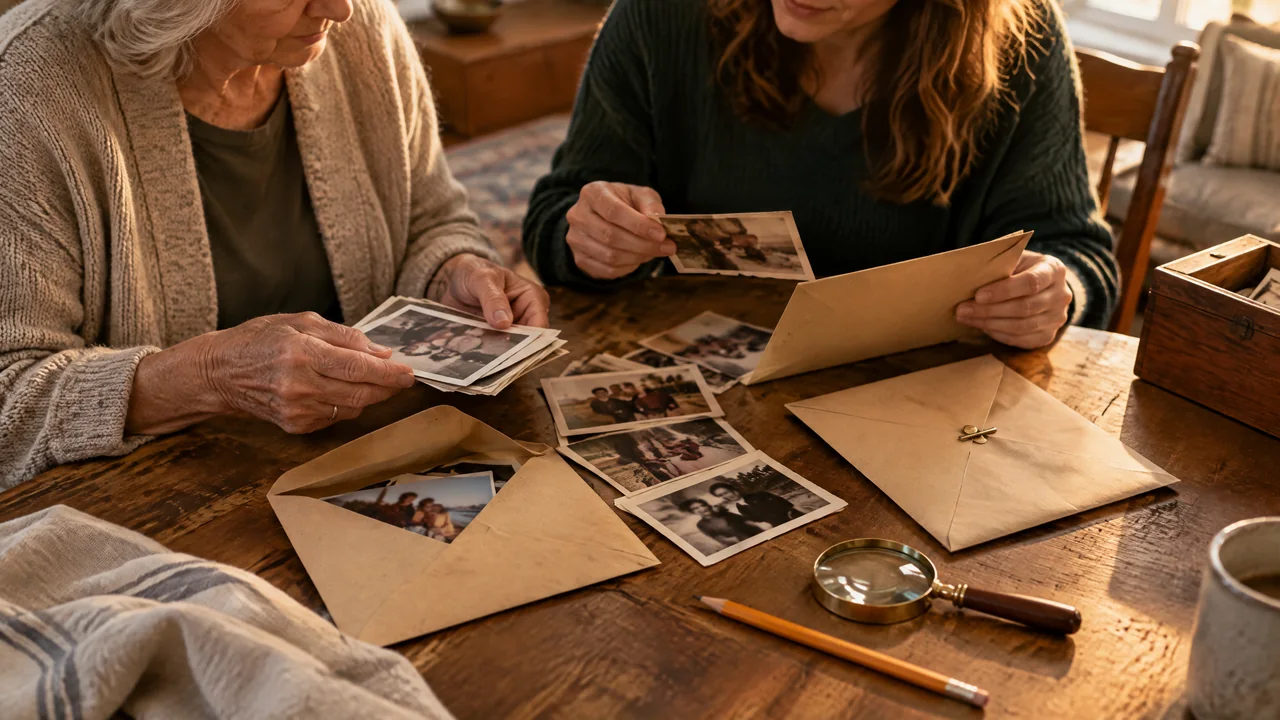
The kindest default is simple: do not add details about a living person to a shared family tree, photo collection, or story file until you know what they are comfortable sharing. A useful family record can still grow when each person chooses their own level of visibility. “No,” “not yet,” and “please leave that out” are all acceptable answers.
Begin with a smaller promise
Instead of asking, “May I put you in the family tree?”, describe one specific use. You might ask whether a cousin is happy for their name and relationship to appear in a private working copy, or whether an aunt is willing for one childhood photograph to be shared at a reunion. A smaller, plain-language question is easier to answer thoughtfully.
For a recorded conversation, informed consent means that a participant understands the project’s purpose, likely uses and storage, and the possible outcomes before agreeing to take part. 2 Professional oral-history guidance similarly recommends explaining the recording, review process, preservation, access, and potential uses before recording begins. 1
Use that standard for family work too: say who may see the material now and later, and whether it may be passed on. A kitchen-table conversation is not permission for every future use.
Separate the material before you share it
A family tree often combines several kinds of information. Keeping them visibly separate prevents a remembered story from looking like a proven fact, and it makes consent choices easier.
Label a research record with its source and date, such as a certificate, newspaper notice, or letter. Label an oral story with who told it and when, without presenting it as settled fact. Keep an unanswered question as a question: “Was this the same Margaret who moved to Leeds?” This is respectful of both history and people who may not wish to have a tentative connection displayed as certain.
For living people, consider four categories rather than one large “profile.” Names and relationships may be useful. Photos may show a face, children, home, or daily life. Contact details belong in a separate voluntary directory, not widely circulated notes. Sensitive stories may concern adoption, estrangement, money, health, identity, addiction, abuse, legal trouble, or a difficult relationship. A detail can matter to its teller and still be unsuitable for a family record.
Agree on boundaries, person by person
Avoid a family-wide assumption such as “we are all fine with sharing.” One sibling may welcome a photo album but prefer no date of birth. Another may be happy to be listed and decline all photographs. Someone else may choose not to appear at all. No contributor owes the project a story, photo, or contact information.
The Oral History Association advises that interviewees should be able to decline subjects and restrict access to an interview; it also notes that a pseudonym can be appropriate in some circumstances. 1 In a family project, the practical equivalent may be an initial, a relationship-only entry, a description without a name, or no entry.
Ask again when the audience changes. Consent to show a photo to close relatives at a birthday lunch is not automatically consent to include it in a printed booklet, a group email, a public post, or a copy sent outside the family. If a story names several living people, seek the views of those who can reasonably be contacted, or remove identifying details and keep the story private.
Use this one-page sharing boundary card
Use one card for each person, photo, interview, or sensitive story. Keep it with the item or in a simple family notes file. It is a conversation aid, not a legal form.
Sharing Boundary Card
- Person or item: ______________________________
- What is okay to include: name / relationship / photo / short memory / other: ______________________________
- Who may see it now: only me / named relatives / a family gathering / other: ______________________________
- What should not be included: address / phone or email / exact dates / children / sensitive story / other: ______________________________
- May it be copied, printed, or sent on? no / ask me first / yes, to: ______________________________
- Would you like to review the wording or image first? yes / no
- If your preference changes, who should be told? ______________________________
- Checked together on: ______________________________
A brief message can make the request feel less awkward: “I am putting together a family record for relatives who want to help. I have a photo and a short note about you. Are you comfortable with me sharing it with [named people]? You can say yes, no, or ask to see it first. I will leave it out if you prefer.”
Write down the answer and the audience, rather than relying on memory. The Boston Public Library notes that consent may be documented through a recorded statement or a signed form; a dated email or family note can also help a small project remember its agreement clearly. 2
Treat photographs and contact details with extra care
Before sharing a photograph, look beyond the main subject. Is another living person recognisable? Does the background show a home, school, workplace, car number plate, or private moment? Does a caption reveal more than the people pictured would choose to share? A photo can be wonderful for a family archive while still being right only for a small, agreed audience.
Keep phone numbers, postal addresses, email addresses, and social-media handles in a separate contact list that people opt into. Give relatives a route to update or remove their own details. Never use the tree as an informal directory simply because someone once supplied a number.
For a sensitive story, ask whether the person wants it recorded at all. If they do, agree on the wording, the audience, and whether they would like to review it. Professional guidance also reminds later users to preserve a narrator’s perspective and to recognise that an oral account is subjective, while checking statements presented as fact when possible. 1
Keep access choices open to change
Preferences can change after a divorce, a move, a bereavement, a new job, or simply a change of mind. Set a gentle review point, such as before the next reunion or when you update the tree. If someone asks for an item to be removed from future sharing, act promptly and confirm what you can change. Be honest that you cannot always retrieve copies already passed to other people, and do not promise that any online or printed version will remain private or disappear everywhere.
A respectful family record does not have to be complete. It needs to be trustworthy in its labels, careful with living people, and welcoming to contributors who choose different limits. The aim is not to collect every detail; it is to leave room for relatives to take part on their own terms.
Optional next step: If you would like a place to explore a shared family-tree project, see MemContinuity’s Family Tree.