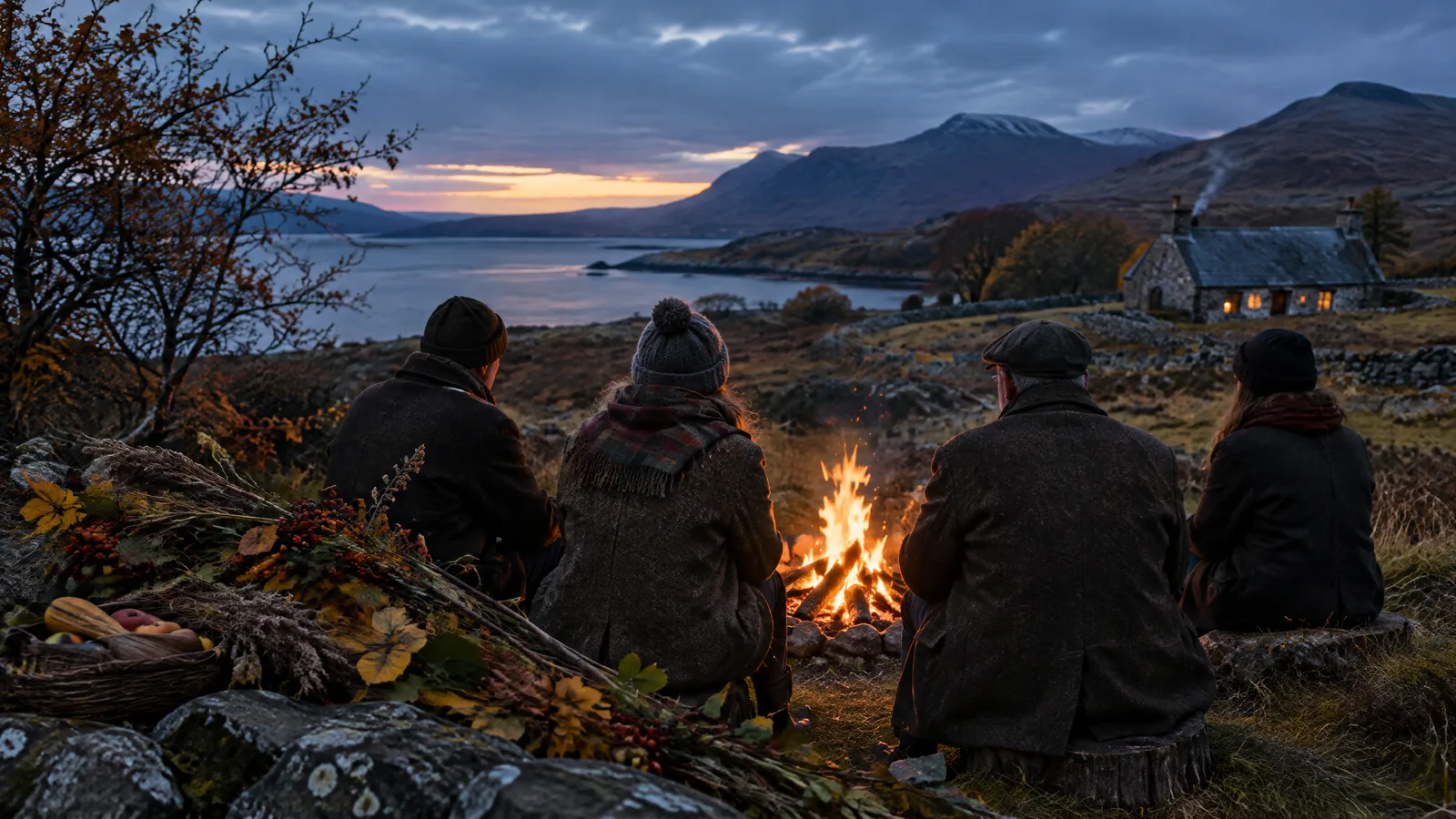
A threshold in the Scottish year
Samhainn is the Scottish Gaelic name for the seasonal observance associated with the beginning of November. Its festivities traditionally began on the preceding evening. In Scottish cultural memory, it marked the close of harvest and a movement from the light half of the year into the darker half. Historic Environment Scotland describes it as a time when people believed the boundary between their world and the otherworld grew less firm, allowing ancestors and fairies to wander. That belief belongs to folklore rather than to a single modern religious practice, but it helps explain why protection, hospitality, storytelling, and prediction all appear in accounts of the season. 1
It is worth approaching Samhainn as a collection of practices shaped by place, household, language, and period, not as one rulebook followed by every community in Scotland. In Scottish Gaelic, Hallowe’en is called Oidhche Shamhna, and an t-Samhain is the name for November. The later place of the observance alongside the Christian calendar is part of its history too: Historic Environment Scotland notes that All Saints Day was moved to the first of November during the eighth century, a change that may have encouraged assimilation with the earlier seasonal festival. 1
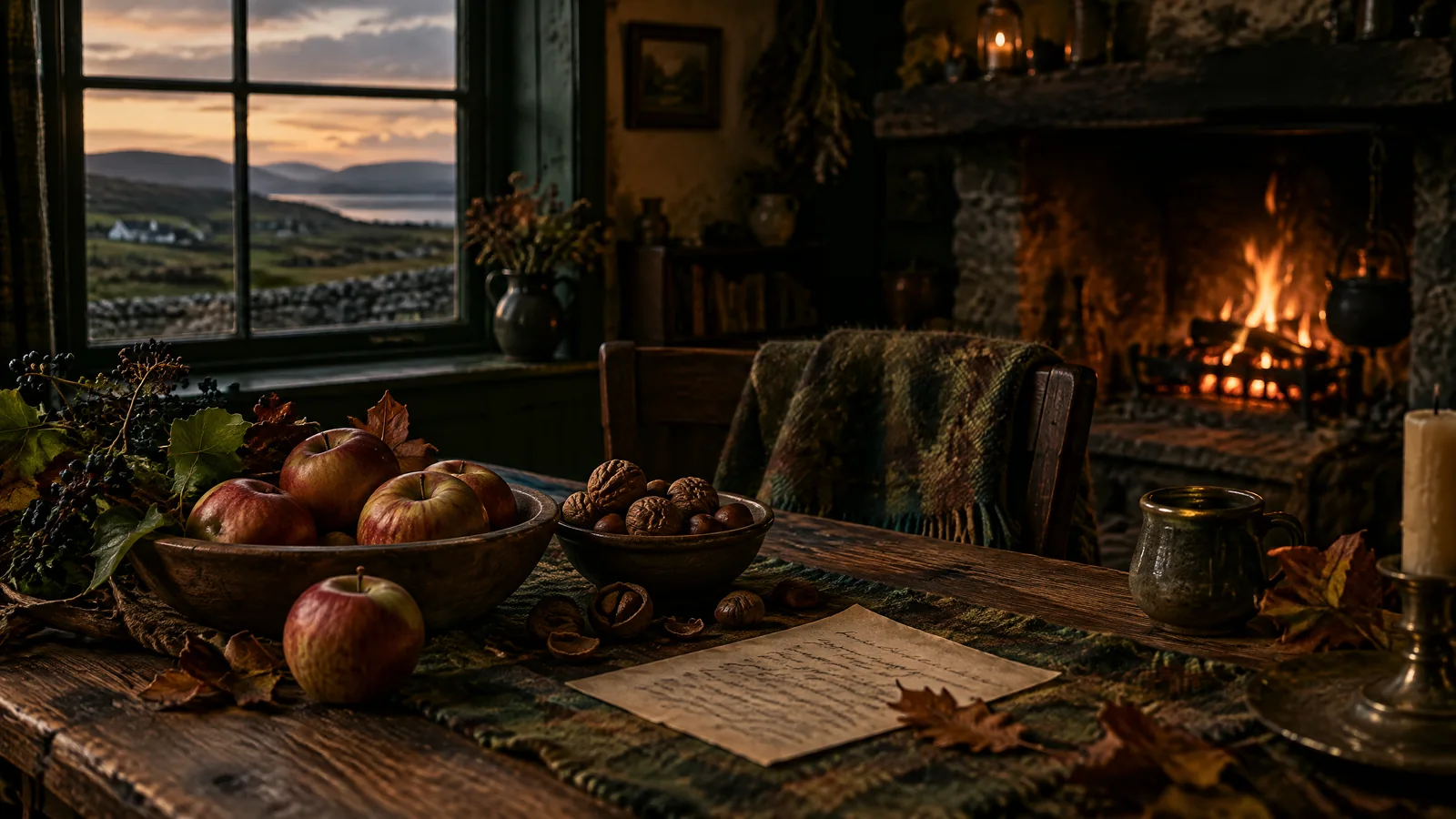
For a meaningful present-day observance, begin with the season itself. Notice what has been gathered, stored, or brought indoors. Make a warm meal with local ingredients. Name the shift toward longer nights without turning it into a performance of fear. This gives the occasion a grounded rhythm and leaves room for people who relate to its Gaelic heritage, family memories, faith, or simple autumnal hospitality in different ways.
Fire and a light in the window
Fire was a conspicuous feature of recorded Scottish Samhainn customs. The Gaelic term samhnagan was used for bonfires intended in folklore as protection against harmful presences. Historic Environment Scotland records competitive household fires on some islands, while on the mainland fires were commonly placed at prominent points in the landscape. These details show how visibly communal the night could be, but they should not be taken as a cue to light a fire anywhere today. 1
A responsible adaptation is modest: use a candle in a stable holder, an electric lantern, or a small lamp by a window, while following household and venue safety rules. Let it stand for warmth, welcome, and attentiveness rather than an attempt to reproduce a rite. If an outdoor fire is part of an organised local event, follow the hosts, permissions, weather guidance, and fire restrictions. The point is care for people and place.
Turnip lanterns offer another vivid Scottish image. Before carved pumpkins became familiar, turnips, called tumshies or neeps in Scots, were hollowed out, given faces, and lit from within. Accounts connect the lanterns with the wish to ward off unwelcome spirits. The National Trust for Scotland describes the turnip’s difficult texture as part of the old craft, so this is best made slowly with an adult handling sharp tools and a safe light source. 1 2
A lantern need not be grotesque. A simple pattern, leaf shape, or quiet face can make a respectful doorstep or table light. Save the scooped flesh for soup or mashed neeps, which keeps the activity connected to food rather than waste.
Guising as neighbourly exchange
Guising is a well-known Scottish custom associated with the season. In recorded explanations, children disguised themselves so that they might pass safely among wandering spirits. They visited neighbours and earned food or treats by offering a joke, song, story, or small performance. The exchange matters: the emphasis was on bringing something to the doorstep, not merely collecting something from it. 1 2
A contemporary household can keep that spirit of reciprocity. Invite children to prepare a short, voluntary performance and make clear that no one owes participation. Ask neighbours first, respect quiet homes, and offer alternatives for people who prefer not to open their doors. A shared song, a Gaelic greeting if it is familiar to those present, or a family tale can be more memorable than a costume alone. Avoid treating old beliefs or Gaelic words as decorative props; explain their context and use them with care.
Games and food also belonged to the social side of the night. Apple dooking, in which an apple is taken from water without using hands, remains a familiar Hallowe’en game. Nut burning was used in folklore to imagine the prospects of a relationship: a quiet burn was read favourably, while hissing or crackling suggested trouble. Kale pulling was another form of fortune seeking, remembered in Robert Burns’s poem Hallowe’en. 1 2
These customs are most considerate when offered as stories about the past rather than promises about anyone’s future. Use clean bowls, individual apples, and accessible alternatives to water games. Let guests opt out of romance-centred activities. The welcome should be wider than the game.
A place for memory
Samhainn can also invite an unshowy act of remembrance. The National Trust for Scotland’s Canna House archive preserves images and film of festivities in South Uist. Its account records food, costumes made from croft materials, and a table place left to welcome the souls of dead relatives. This is a specific Hebridean record, not evidence that every Scottish household kept the same custom. 3
That distinction makes it possible to draw inspiration without claiming ownership of a practice. At a family meal, set aside a few minutes to share a name, photograph, recipe, or story of someone missed. Leave a chair empty only if it feels comforting to the people present. A small bowl of fuarag, a mixture of toasted oats and whipped cream recorded for Samhainn, may begin a conversation about older foodways; Historic Environment Scotland notes that tokens were sometimes folded into it for fortune telling. Choose plain servings if hidden objects would create a safety risk. 1
The most respectful Samhainn gathering is not the most elaborate one. It is one that notices the turning season, makes room for neighbours, and treats inherited stories with humility. Whether marked in Gaelic, Scots, English, or quietly at home, the occasion can remain a living Scottish seasonal tradition when its local texture, consent, safety, and memories are given equal care.