Ga Fantasy Coffins in Ghana: A Portrait in Wood
In parts of the Greater Accra area, some Ga families commission coffins that take an unmistakably personal form: a fish, an animal, a tool, a vehicle, a food item, or another object linked to the person being honoured. Often called Ga fantasy coffins in English, these works are not a blanket description of funeral practice across Ghana. They belong to particular communities, families, artists, and occasions. Their vivid shapes have made them familiar in museums, but their first meaning is close to home: they can help a family mark a life through a carefully made object.1 2
A coffin that speaks through form
The strength of this tradition lies in its ability to make an idea visible. A chosen form may refer to work, status, aspiration, character, or a connection remembered by relatives. The Smithsonian describes examples in which an airplane can suit a traveller and a chilli pepper can suit a market woman. It also stresses that each imaginative form points to an important aspect of the deceased’s life.3
That does not make the image a puzzle with one universal answer. A symbol can carry a family story that outsiders do not know. A fish might have professional, personal, or proverbial associations. An object that appears playful in a gallery may have been selected with serious tenderness. The most responsible way to look is to treat the form as an invitation to learn that it represents a person, not as a prompt to guess at a life.
The Museum of New Mexico Foundation places this symbolism within Ga cosmology. Its exhibition text describes the coffin as a vehicle toward the ancestral realm and as a bearer of meaning about the life just lived. It notes that families may work with an artist on forms linked to profession, status, or aspiration.1 The commission is therefore both material and relational: wood, paint, skill, memory, conversation, and family judgement all meet in one object.
Workshop knowledge and individual hands
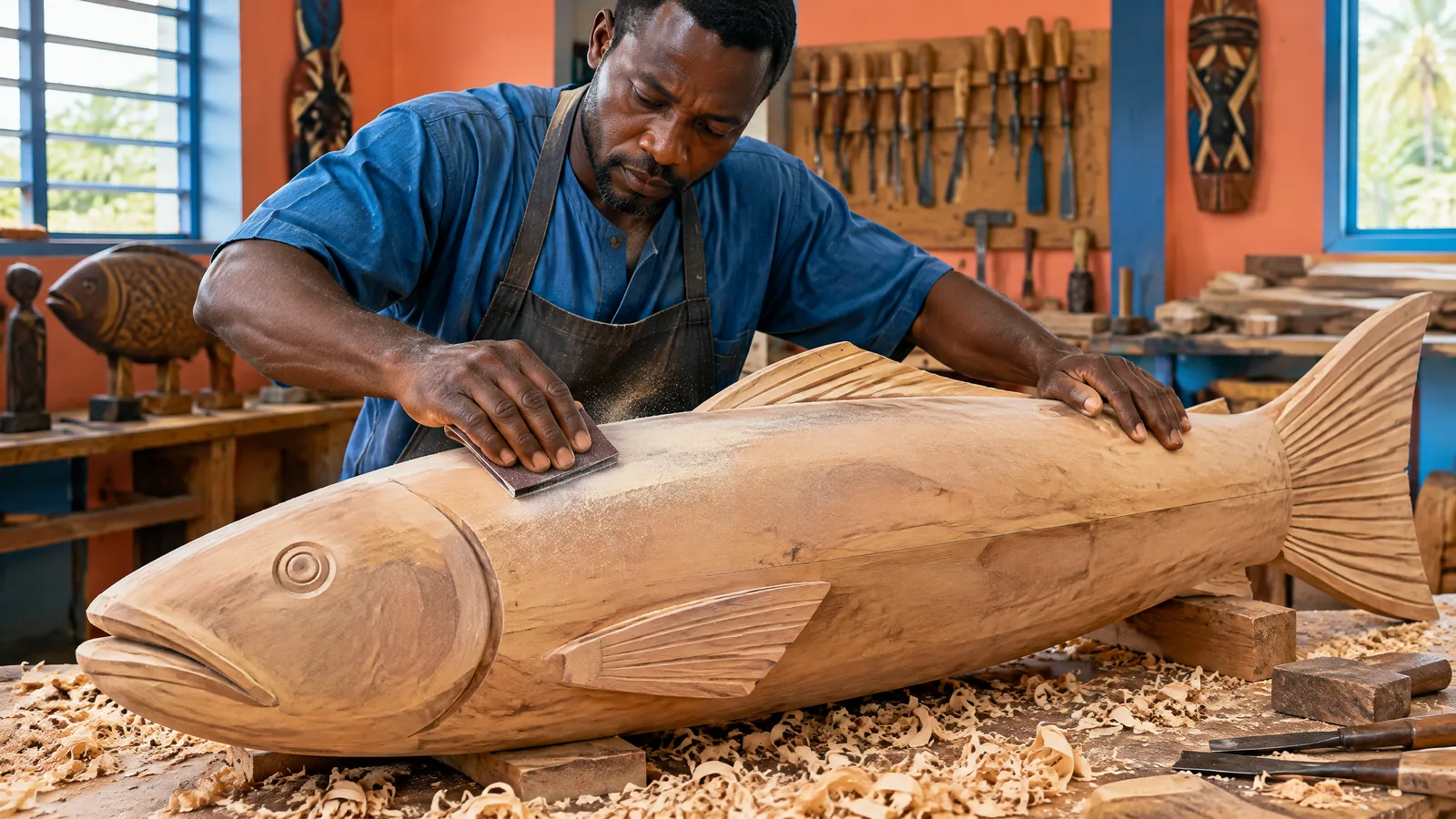
The coffins are made through woodworking expertise, not mass production. Smithsonian collection records describe wooden structures built from planks, then shaped, painted, and lined with cloth.2 Their bold surfaces can conceal substantial technical demands. A maker must devise a form that can function as a coffin while retaining a clear silhouette and a finished interior.
Artist lineages matter here. The Smithsonian identifies Kane Kwei as the artist who developed and popularised fantasy coffins in the nineteen fifties. It names Paa Joe as Kwei’s leading student and successor.2 The Museum of New Mexico Foundation likewise traces a workshop lineage through Paa Joe, Cedi Anang, Jacob Tetteh Ashong, Daniel Mensah, and Eric Adjetey Anang. In that account, carving, sanding, and storytelling move from hand to hand in the workshop.1
This history helps explain why authorship deserves attention. It is tempting to speak only of a striking object, yet every coffin reflects decisions by named makers and by the people who commissioned it. Credit to artists and workshops recognises living expertise. It also prevents the tradition from being treated as anonymous decoration.
A practice with more than one setting
Some figurative coffins are made for burial, while others are commissioned for museums, galleries, or collectors. The distinction is important. A Smithsonian record notes that such coffins are made both for local use and for export, and the Museum of New Mexico Foundation describes their later life as sculptural works that circulate outside Ghana.1 3
Museum display can make craft visible to audiences who would otherwise never encounter it. At the same time, an exhibition setting cannot reproduce the relationships or beliefs involved when a coffin is made for a family. A gallery label may identify the artist, wood, paint, and shape. It cannot fully hold a loved one’s voice, the conversations behind the commission, or the place of a funeral within community life.
For that reason, it is useful to keep two truths together. These coffins are accomplished works of contemporary art, and they can be funerary objects with intimate significance. Neither description cancels the other. The respectful response is not to turn death into spectacle, nor to treat creative skill as secondary to ritual. It is to recognise the care and knowledge that make both dimensions possible.
Looking with care
A practical starting point is to ask whose story a form is carrying. When reliable information is available, begin with the maker’s name, workshop, place, and the context of commission. Then notice the joins, painted detail, lining, scale, and balance that reveal the carpenter’s skill. Finally, accept that some meaning may remain with the family. Not every remembrance needs to be decoded for a public audience.
This approach also keeps the geographical framing accurate. Ga fantasy coffins are closely associated with Ga communities and workshops in the Accra area; they should not be presented as if they speak for every community in Ghana.1 Their continuing power comes from specificity. A form chosen for one person can hold labour, affection, aspiration, faith, and family memory without reducing any of those things to a single label.
When seen with that care, the coffin’s visual confidence has a quieter counterpart. Beneath the colour and recognisable outline is a skilled act of remembrance: a family and an artist using form to say that a particular life mattered.