Egungun Traditions in Yoruba Communities of Nigeria: Memory in Motion
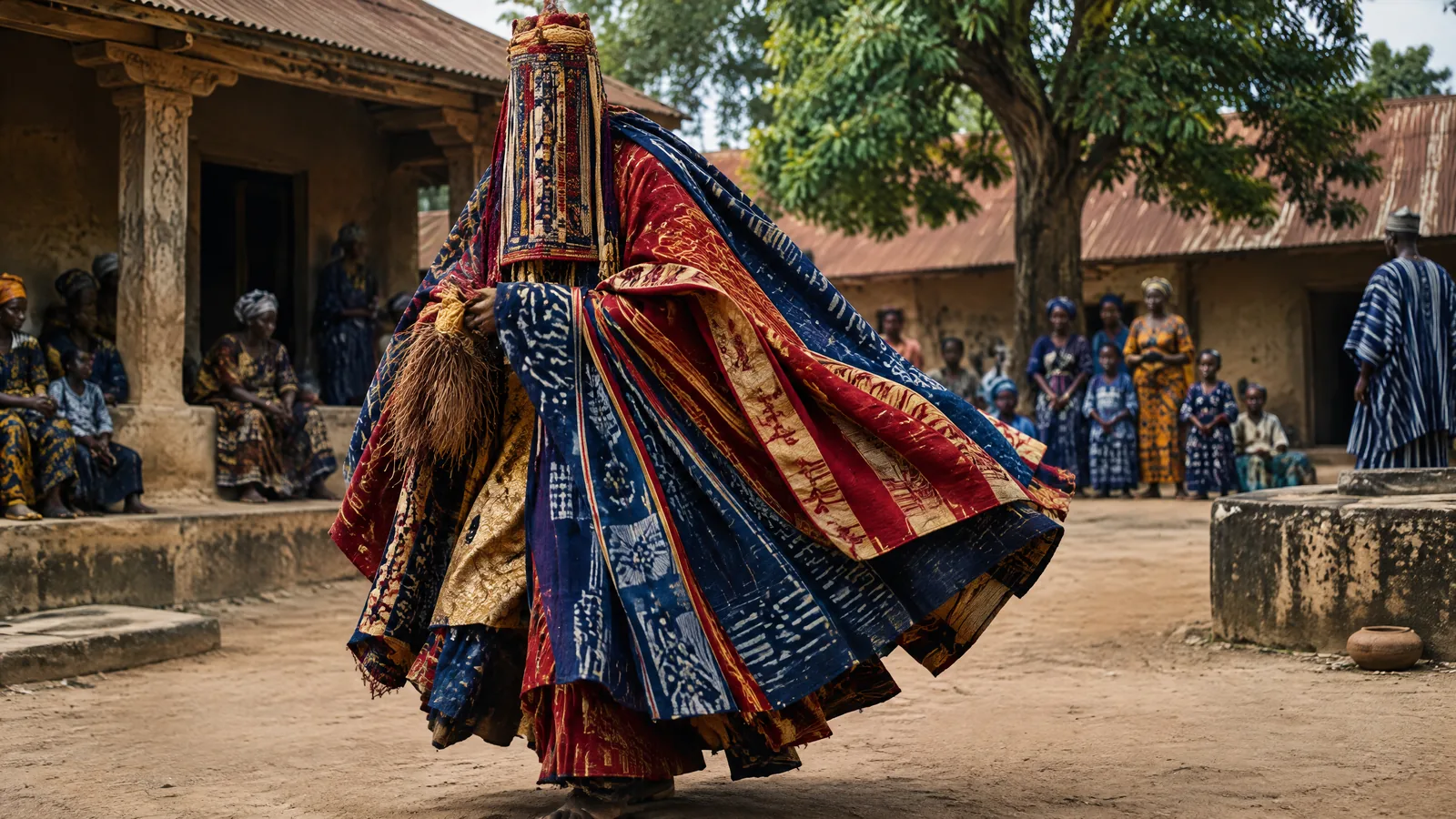
Egungun traditions are living forms of remembrance among some Yoruba communities in southwestern Nigeria. They bring lineage history into public view through masked performance, music, movement, praise, and richly made regalia. The occasion can be visually exuberant, but it should not be mistaken for a costume display detached from belief or family responsibility. In the Yoruba settings described by the Smithsonian, an egungun embodies ancestral power and performances honor named forebears or a collective lineage. 1
Nigeria contains many communities, histories, and faiths. Egungun is therefore not a single ceremony observed in the same way by everyone in the country, nor is there one fixed form for all Yoruba communities. The Smithsonian notes localized styles across the Yoruba region, while its account of Oyo Yoruba practice places performances within lineage compounds as well as public settings. 1 Paying attention to that local ownership is the first step toward understanding the tradition with care.
A relationship between lineage and presence
The word egungun can refer to an ancestral spirit understood to return temporarily among the living, and it can also refer to the striking regalia associated with that presence. Cornell University’s Johnson Museum explains that, within the Yoruba religious worldview represented in its exhibition, ancestors may be understood to affect daily life and are invoked at local annual festivals through music, poetry, song, and dance. 2 This is not simply memory as looking backward. It is a relationship in which family history, moral responsibility, and present community life are held together.
In Oyo Yoruba communities, the Smithsonian describes festivals known as Odun Egungun, with performances that may take place at a lineage compound and also in marketplaces or before a palace. 1 The setting matters. A performance connected to a particular family or association has obligations and meanings that cannot be read from photographs alone. Public visibility does not make every part of the tradition public property.
The ancestors honored are often linked to a lineage rather than presented as distant, anonymous figures. The Art Institute of Chicago’s account of Yoruba Egungun performance describes oral praise poetry, or oríkì, as a way histories and valued actions can be carried forward. It also speaks of Egungun as a means of keeping treasured memories alive. 3 For families, this can make names, stories, qualities, and responsibilities available to another generation.
Regalia made for movement
An Egungun ensemble is designed to be experienced in motion. In a form described by the Smithsonian, strips and panels of cloth hang from a covered wooden board balanced on the performer’s head. Layering conceals the wearer’s body, even during active dancing, while the panels flare, ripple, and change the silhouette. 1 Cornell likewise describes layered cloth arranged to swirl outward in dance, creating a sense of an otherworldly presence. 2
This motion is part of the meaning, not an accessory to it. Cloth carries colour, texture, family investment, and the skill of people who make and maintain the ensemble. The Smithsonian explains that panels can be added over time by owners or lineage members, sometimes to honor or seek favor with the ancestral spirit. The accumulation can therefore hold a material history of care as well as an aesthetic one. 1
Materials may combine handwoven cloth with imported fabrics, beads, shells, or other objects. Their selection can signal regard for the ancestors and the standing of the family that commissions or tends the regalia. 1 2 Yet no single item provides a universal key to interpretation. Meanings depend on the maker, lineage, locality, and ritual setting. Looking closely is worthwhile; assuming that every colour or panel has a portable, fixed message is not.
Many people sustain the tradition
A visible performer is only one part of a broader social world. Cornell’s exhibition emphasizes that creating an egungun can involve ritual specialists, a commissioner, the head of a local Egungun association, a herbalist, and a tailor. It also notes that the process is sensitive and not fully open to public handling or display. 2 That collaboration helps explain why regalia should be treated as more than fabric or an art object.
Women’s contributions also deserve careful recognition without flattening local differences. In an Art Institute lecture focused on Oyo Yoruba contexts, scholar Moyo Okediji discusses women commissioning Egungun representations and participating prominently in the consecration of costumes. 3 This account is a reminder that a tradition may involve family members, artists, organizers, and ritual authorities in roles that vary by community and circumstance.
Transmission is often practical as well as spoken. A younger relative may learn by hearing lineage stories, observing preparation, helping care for textiles when invited, or listening as elders explain why a particular representation matters. Recording family recollections with consent can support this work. So can identifying photographs accurately, preserving the names of makers where they are known, and allowing relatives to decide which stories remain private.
Respecting boundaries at public occasions
For guests, respect begins with accepting that invitation and access are not the same thing. Some performances may occur in public spaces, but shrines, lineage compounds, preparation, ritual knowledge, and personal acts of remembrance may be restricted. Do not enter a family or association space without an explicit welcome. Do not touch regalia, ask a performer to pose, or treat a sacred appearance as entertainment on demand. Cornell’s museum staff changed the care and display of its regalia after consultation with a Yoruba priest and scholar; that example shows why community protocol should lead. 2
Photography also needs care. Ask before making close images of performers, families, children, or preparations, and accept a refusal without argument. Follow the directions of hosts, organizers, and local authorities. If a gathering allows observation, give people room to move and keep attention on the occasion rather than on obtaining a dramatic image. A respectful guest listens more than they interpret.
Keeping memory connected to people
Egungun traditions show how remembrance can be made tangible through art, performance, lineage knowledge, and collective responsibility. Their power does not rest only in bright cloth or energetic dance. It rests in relationships: between those remembered and those who continue to care for their names, between makers and materials, and between communities and the protocols that protect what matters.
The most useful way to approach Egungun in Nigeria is to keep that human context in view. Learn from Yoruba voices and institutions, name a locality when one is known, and let families and associations define the limits of what may be shared. That attention preserves the difference between appreciating a living heritage and claiming access to a practice that belongs to particular communities.