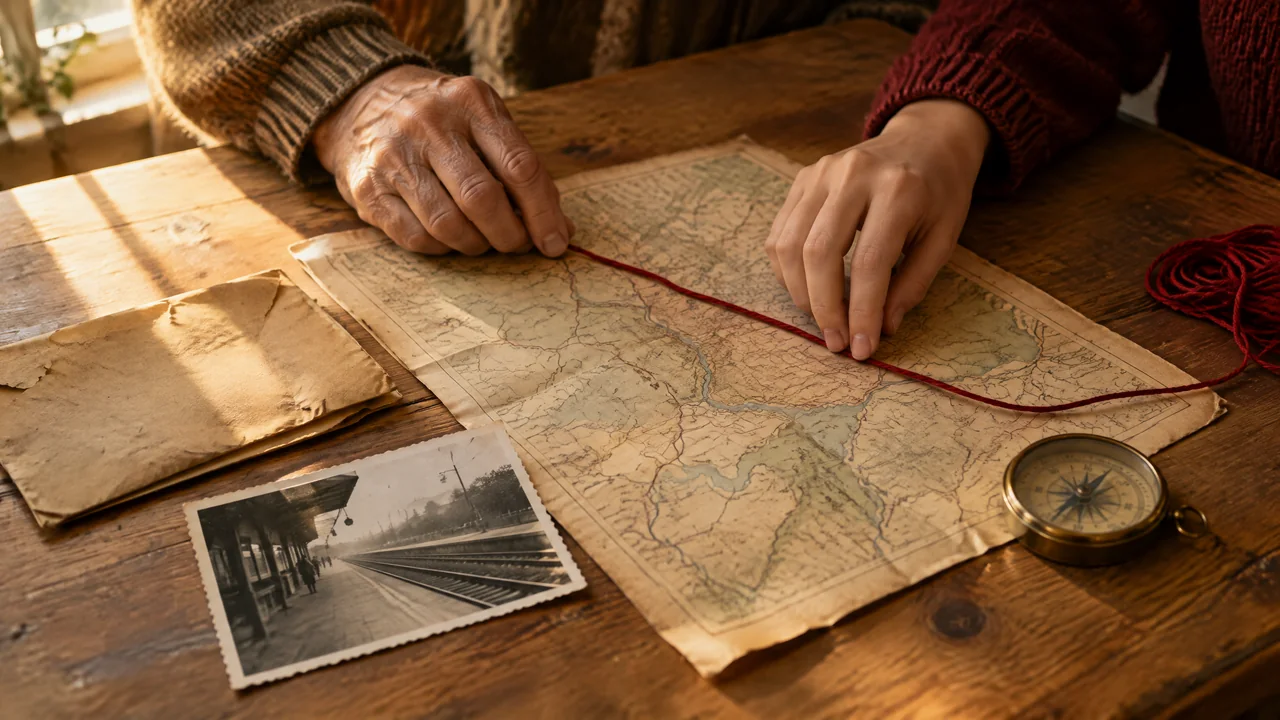
Start with a place timeline, not a dramatic arrow on a map. For each person, note where they were at known moments, what supports that note, and what remains unknown. A map made this way can become a shared family working paper: clear enough to be useful, but honest enough to be corrected.
Build the timeline before you draw the route
Choose one person or household and work from the most secure information outward. A birth record, an address in a census, a marriage record, a dated letter, a school photograph, or an arrival record can each anchor a place at a particular time. Write the place as it appeared in the source, then add the present-day place name separately if it helps relatives recognise it.
Census records are especially useful stepping stones. In United States federal census schedules from 1850 to 1950, individual household entries can include birthplace, immigration year, street address and occupation, although the details vary by census year. 1 A passenger arrival record may add a last residence, entry date, vessel, birthplace or the relative a person intended to join. 2 Neither type of record tells the whole story, but together they can point to the next place and date to investigate.
Do not force a continuous journey where the evidence only gives two points. If someone appears in one town in 1910 and another in 1920, record the move as happening sometime within that interval. The route, reason and exact year may be possibilities rather than facts.
Give every contribution a clear label
A family map becomes more dependable when everyone can see the difference between a research record, an oral story and an unanswered question. These are all valuable, but they do different jobs. A record may establish that a household was counted at an address. A story may explain that a move was remembered as a search for work, a wish to be near siblings, or a return after bereavement. A question keeps the group from turning a guess into a settled fact.
Use this simple Move Card for every suggested journey. It is deliberately short enough for a relative to complete by phone, email or at a family gathering.
Person or household:
From — place and approximate dates:
To — place and approximate dates:
Research record: title or description, date, and where it was found
Oral story: who remembers or passed it on, and when it was shared
What we can say confidently:
What we think may have happened:
Question for this branch:
May this be shared with the wider family group? yes / no / ask me first
Keep the wording of a story close to the speaker’s own words. “Grandmother said they went west after the mill closed” is more accurate than “They moved because the mill closed” unless a record confirms it. If two versions differ, preserve both with their sources rather than choosing the neatest version.
Put places on a map with modesty
Once you have several dated points, map them in order. A printed map, a blank outline map or a shared sketch all work. Use a solid line only for a movement supported by a dated record or a first-hand account with a clear time frame. Use a dotted line, a question mark or no connecting line where the route is inferred. Put the evidence label beside the place in your notes, even if the map itself stays uncluttered.
Look for patterns without treating them as proof. Several cousins moving to the same district might suggest kinship networks, work opportunities, or a familiar language community. It might also be coincidence. Let the pattern generate a question: “Who was already there?” Then ask a branch with roots in that place to look for a letter, address book, photograph, newspaper clipping or local memory.
Maps can also correct a misleading family phrase. “From the old country” may conceal several moves across villages, regions or borders. An address may be a temporary stop, not a final destination. Marking dates beside places helps a family distinguish a childhood home, a port of departure and a later settled home.
Ask branches for a small, specific piece
A general request for “anything about our ancestors” can feel too large. Instead, give each family branch one manageable gap. One cousin might check whether their grandparents kept correspondence. Another might identify the town in a captionless photograph. A relative who does not enjoy research may simply say which stories they would rather keep private, or opt out entirely. That is a valid contribution.
Here is a message you can adapt:
We are putting together a careful timeline of how our family moved between places. Your branch may know about the period when the family was connected to [place] around [years]. If you are comfortable, could you share one record, photo, letter, story or question? Please tell us whether it is okay to pass it to the wider family group. There is no pressure to take part, and it is completely fine to say no.
Invite a reply in the person’s preferred form. A five-minute call, a voice note or a photo of the front and back of an old postcard may be more realistic than a written account. Thank contributors for corrections as warmly as for new material.
Let letters and stories add texture, not certainty
Letters can make movement visible in a way that formal records cannot. A return address, postmark, mention of a landlord, a description of weather, or a request for someone to visit may narrow a timeline. Record the date, writer, recipient and the physical item’s owner. If only a family recollection of the letter survives, label it as a story rather than treating it as the letter itself.
Oral-history guidance likewise emphasises that narrators should know the purpose of an interview, possible uses and access plans, and should be able to refuse subjects or restrict access. It also recognises oral testimony as subjective and recommends checking factual assertions where possible. 3 For a family project, explain plainly who may hear a story, do not record or circulate it without permission, and revisit that agreement if the intended audience changes. Respect for living people matters more than filling a blank on the map.
Keep the next question visible
At the end of each conversation, choose one next step: compare two dates, identify an old place name, ask permission to view a letter, or check whether two households lived near each other. Add the question to the relevant Move Card, with the contributor’s name only if they agree. This prevents a map from becoming a polished-looking final answer. It stays a family record of what is known, what is remembered and what the next generation might discover.
If your family would like an optional place to explore a continuing tree project, see MemContinuity’s Family Tree.