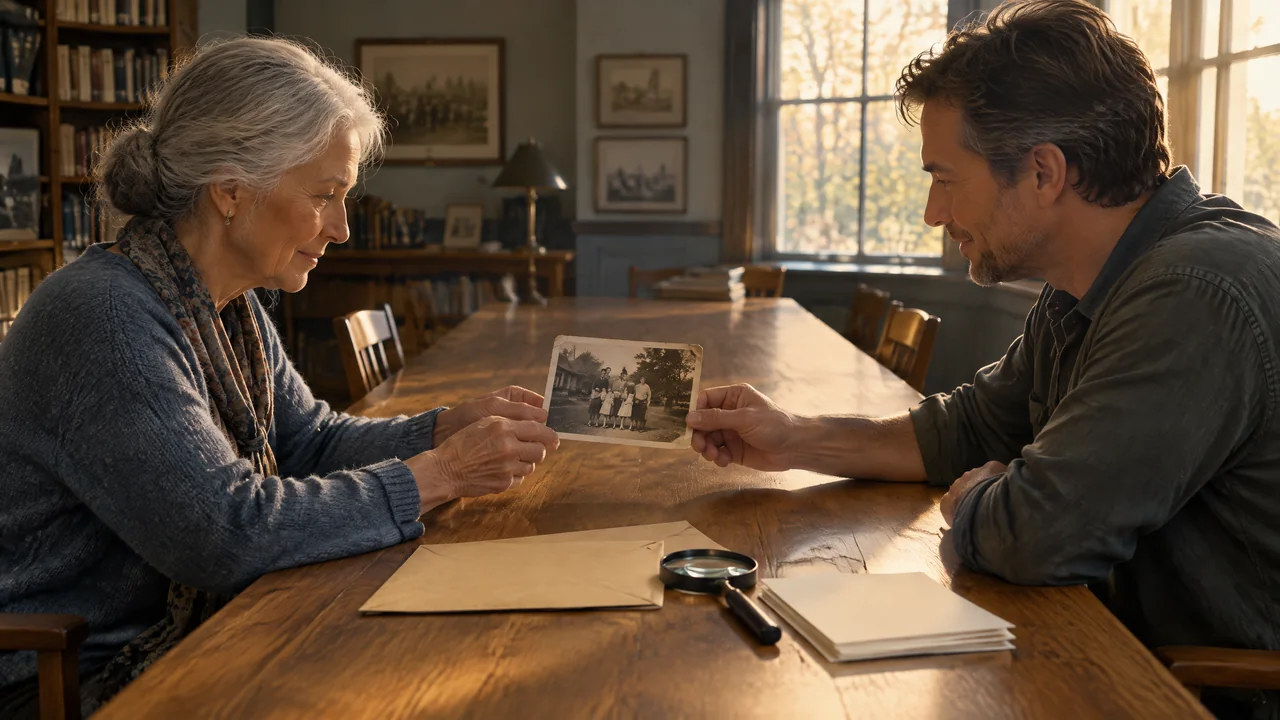
Start small: say who you are, name the family line you are exploring, and let the other person choose whether to reply. A distant cousin may be pleased, uncertain, busy, or not interested. Each response deserves respect.
Begin with a modest, well-supported reason to write
Before you send a message, decide what you actually know and what you are still trying to learn. A similar surname, a match in an online tree, or a shared town can be a useful lead. It is not yet a family relationship to announce with certainty.
Make three small notes for yourself. First, list research records: documents or images you can identify, such as a census, passenger list, obituary, land record, or photograph. The U.S. National Archives identifies census, military, immigration, naturalization, and land records among the sources commonly used in genealogy. 1
Second, list oral stories separately. A grandmother’s memory, a repeated family saying, or a neighbour’s recollection can point you toward useful questions. Label it as a story rather than treating it as a settled fact.
Third, write down unanswered questions. For example: “Was Daniel Harper, born around 1890 in Leeds, the same man who moved to Halifax?” This separation helps you be candid and gives a possible cousin room to correct a detail.
Choose one or two calm facts for your first contact: a name, an approximate year, a place, and the earlier relative you think may connect you. Professional genealogy guidance emphasises clear communication based on reliable, fully cited evidence rather than withholding or misrepresenting sources. 2
Prepare a respectful first contact
Use the name and contact method the person has made available. Do not turn a public clue into an invitation to search for private phone numbers, home addresses, workplace details, or relatives who have not chosen to be involved. A short message is kinder than a long account of your research.
Say why you are writing, not what you expect them to provide. Avoid phrases such as “we need to talk” or “you are definitely my cousin.” Do not begin with sensitive family matters, health information, DNA details, adoption, or surprises that may affect other living people. If a connection arose from genetic genealogy, it is enough to say that you are researching a possible shared ancestral line unless the other person has already chosen to discuss more.
Here is a concise first message that can be adapted:
Hello [Name], I hope it is all right to get in touch. I am [Your name], and I am researching the [Surname] family from [place] around [year]. My records suggest that [earlier relative’s name] may connect our branches, but I am still checking this. I have a [record or photograph] that may be relevant and would be happy to share it if you are interested. There is no pressure to reply or share anything. Warm wishes, [Your name]
Do not attach a large file, chart, or private material to that first message. Offer a small, non-sensitive item instead. If there is no reply, one gentle follow-up after a reasonable interval is enough. Then let the silence stand. Opting out is acceptable, and so is changing one’s mind later.
Use a one-page outreach check before you send
This checklist is a practical pause.
- Purpose: I can state my reason for writing in one sentence: ________.
- Possible link: The earlier relative, place, and approximate period are: ________.
- Record basis: The item I can name or cite is: ________.
- Story label: The family story I will describe as a story, not proof, is: ________.
- Open question: What I hope to learn is: ________.
- Minimum sharing: In this message I will share only: ________.
- Living people: I have removed or generalised details about people who have not agreed to share them: yes / needs attention.
- Choice: My message clearly says that no reply or sharing is required: yes / revise.
If your notes contain something painful, disputed, or potentially identifying, leave it out of the opening. You can ask later, in plain language, whether the person would like to hear about it. The National Genealogical Society advises family historians to tell people who provide family information how it may be used, to respect their conditions and reservations, and to seek evidence of consent before assuming that living people agree to further sharing or publication. 3
Verify together without putting anyone on the spot
A friendly reply is an invitation to continue a conversation, not confirmation of a relationship. Compare details gently. Ask whether the person recognises a name, place, occupation, photograph, or date. Invite them to tell you what seems right, what seems unfamiliar, and what they would rather not discuss.
When a detail appears to fit, look for another independent record or a clearer connection between generations. Keep the language proportional: “This may be our link,” “the dates seem consistent,” or “I would like to check one more source.” If a story and a record disagree, preserve both with clear labels and note the conflict. A living family tree becomes more useful when it shows what is documented, what is remembered, and what remains unresolved.
Give credit when someone shares a memory, scan, or correction. Ask before forwarding it to another relative or adding it to a group conversation. APG’s professional code calls for safeguarding information about living people, maintaining confidentiality, and obtaining informed consent before using or publicly sharing information. 2 That is a sound habit for a family project even when everyone is acting as a volunteer.
Let privacy set the pace of the relationship
You do not need a full biography, document collection, or access to someone’s contacts to test the connection. Keep early exchanges limited to the question at hand. If you want to save a photo, quote a story, name a living person, or introduce another relative, ask separately and explain the intended use in ordinary words.
Be especially careful with exact birth dates, addresses, financial matters, genetic information, private family conflict, and information about children or other non-participants. NGS guidance specifically says that personal identifying information about living people should be conveyed only in ways they have expressly agreed to. 3 Even public information can feel different when gathered and retold.
A good outcome is not always a new correspondence. Sometimes it is a polite “not now,” a correction to your notes, or no answer. Accept it without argument. Leave your contact details once, keep your notes honest, and remain open to a future reply.
Optional next step: If you would like a quiet place to explore a shared family-tree project, see MemContinuity’s Family Tree.