A monthly Roots Check-In can be a calm 25-minute habit: share one item, settle one small decision, name one unanswered question, and leave with one voluntary next step. Keeping research records, oral stories, and open questions in separate lanes lets the family tree grow without treating every memory as a proven fact.
Make the rhythm small enough to keep
Choose a regular moment that feels light rather than demanding. The first Sunday of the month after lunch, or the third Wednesday evening, can work if it suits your family. Try it for four months before deciding whether to continue, shorten it, or pause it. A missed month is not a failure.
Invite a small circle at first: perhaps the person who enjoys old photographs, a relative with family stories, and someone willing to look at records. Others can send a note, a scan, or a voice message instead of attending. Send a gentle reminder two days ahead with the date, length, and one question to consider. Rotate the host and note-taker if people wish; neither role requires expertise.
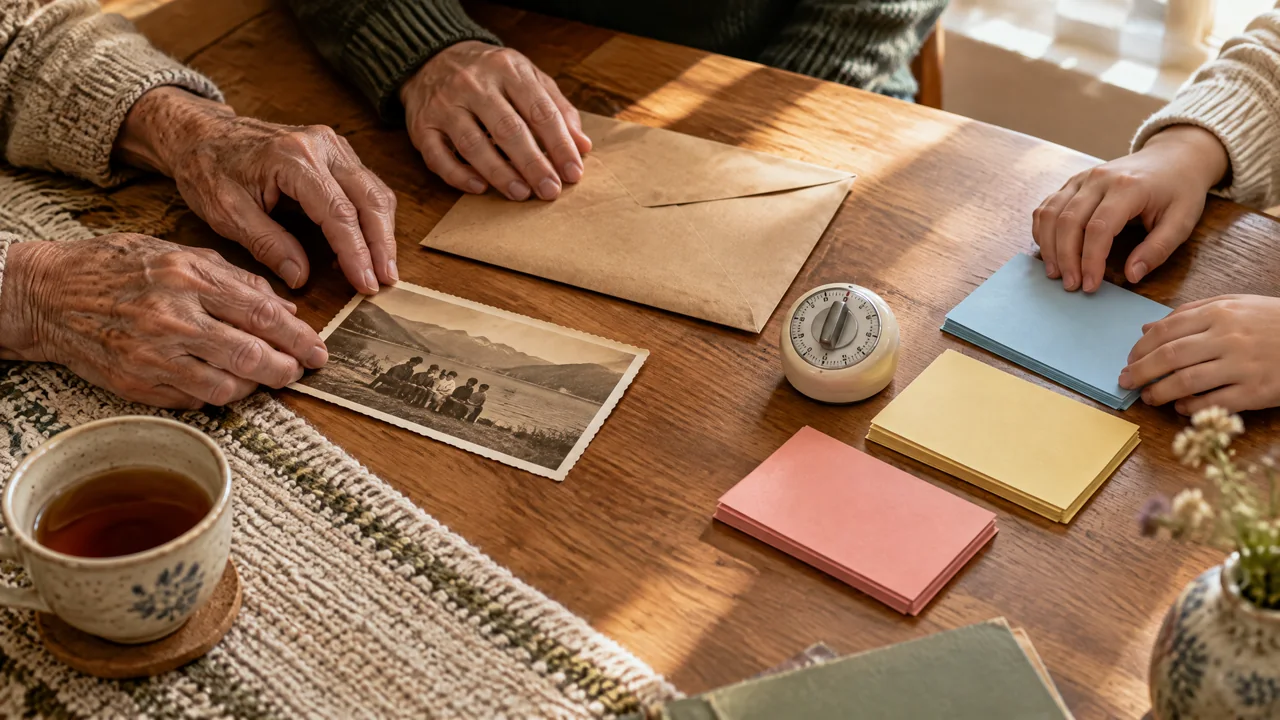
Use one gentle 25-minute agenda
A short agenda protects the meeting from becoming a long hunt through papers or a debate about every detail. Meet in a kitchen, by phone, or in whatever way is accessible.
- Minutes 0–3 — Welcome and boundaries. Confirm that anyone may pass on a topic and name anything that should stay within the group.
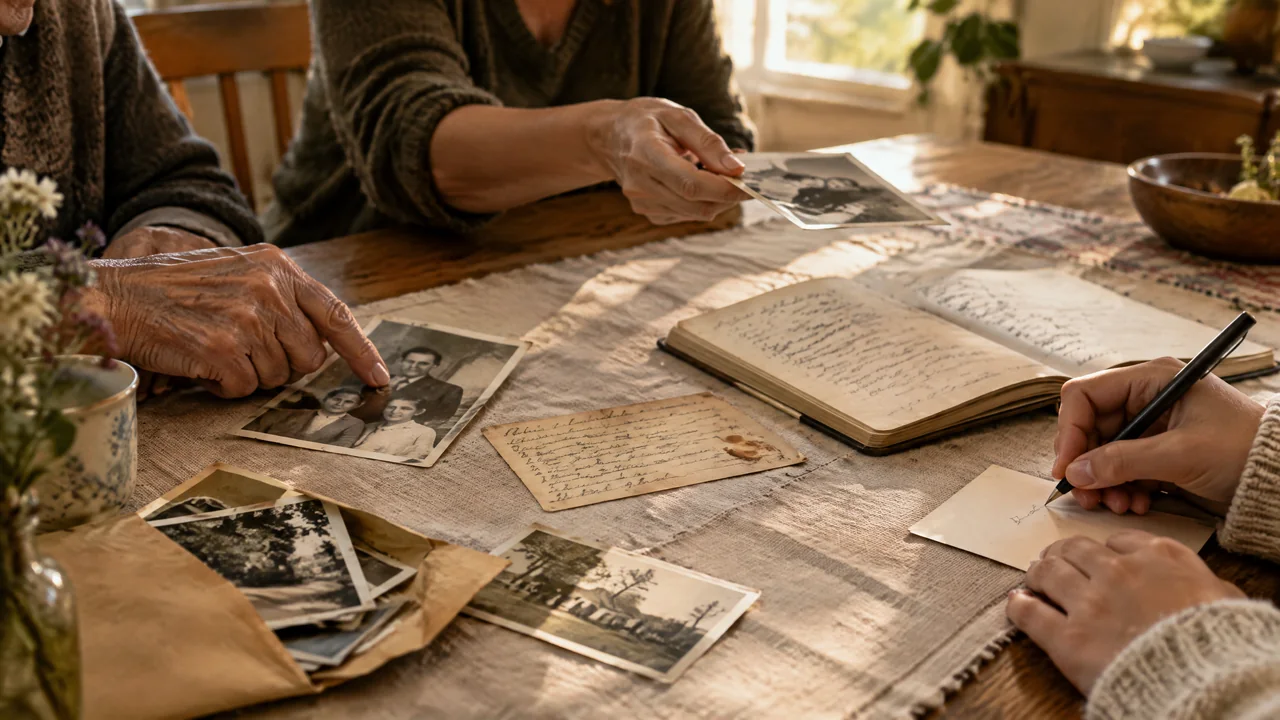
- Minutes 3–10 — One new contribution. Look at one record, photograph, letter, or story—not a whole box at once.
- Minutes 10–16 — Sort it. Place it in the research-record, oral-story, or unanswered-question lane. Add the source or speaker’s name and the date shared.
- Minutes 16–21 — Make one small decision. For example, label a photograph “possibly Aunt Rosa, not confirmed,” or ask a cousin for a reunion date.
- Minutes 21–25 — Choose the next step. One person may volunteer. If nobody does, leave it on the question list without blame.
End on time. A reliable ending makes it easier for people to return.
Keep records, stories, and questions visibly distinct
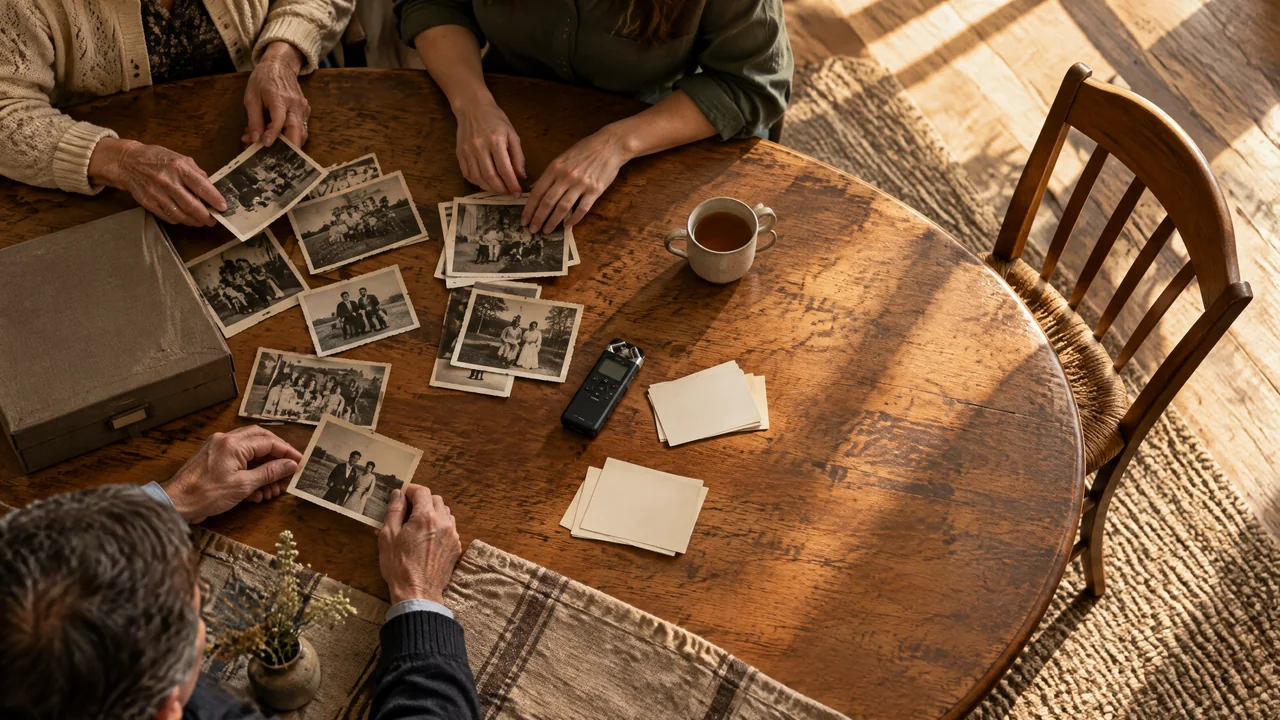
A research record is something that can be identified and revisited, such as a census image, certificate, letter, photograph, or archive reference. Note where it came from and what it seems to say. The Board for Certification of Genealogists identifies source citation and the separation of comments from source information as core parts of careful genealogical work.1
An oral story is a person’s recollection, family saying, or interpretation. It can be precious even when dates or sequence remain uncertain. Record who told it, when, and the detail they want remembered. Oral-history guidance notes the subjectivity of interviews and advises verification where an interview statement is treated as factual.2
An unanswered question is a useful work list, not a failure. “Which town did Grandfather leave from?” or “Who is the child beside Nana?” can remain open until a record or later conversation adds something useful. Do not move a question into the fact column just because it has been repeated often.
Copy this Monthly Roots Check-In worksheet
Use one sheet for each meeting, in a notebook, shared document, or printed folder.
- Date and participants: __________. Contributions sent by someone absent: __________.
- Comfort check: Is there a topic anyone would rather skip? Is any item for this group only, for now? __________.
- Item reviewed and source: What is it, and who supplied it? __________.
- Lane: Research record / oral story / unanswered question. Circle one.
- Meaning and limit: What does it suggest? __________. What does it not prove? __________.
- Decision note: What will we call, label, postpone, or seek next? __________. Date: __________.
- Open-question card: Exact question: __________. Best next place to look or person to ask: __________. Volunteer, if any: __________.
- Privacy and next date: Has a living person been named? Have we asked before sharing beyond this circle? __________. Next check-in: __________.
The “what it does not prove” line is useful. A passenger list may support a journey without settling every relationship. A vivid story may explain why the journey mattered without supplying a date. This small separation prevents a confident-looking guess from becoming fixed family history.
Turn conversation into modest decision notes
A decision note is not a verdict on a person’s life. It records what the group agreed to do with the information at hand: “September 12: leave the parent link unconfirmed; compare two birth records next month.” Add who made the note and what material was discussed.
This makes change normal. A later document may correct an earlier label, and a relative may remember an important detail later. The BCG’s research standards emphasize focused questions, careful data collection, and conclusions based on assessed evidence rather than assumptions.1 Your notes can show that a conclusion is provisional without making the project feel formal or unfriendly.
Invite people without asking them to perform
Some relatives will gladly bring stories. Others may be busy, private, grieving, unsure of their memory, or simply uninterested. Every response is acceptable. Do not assign anyone the job of representing a whole branch. An invitation should make declining easy and should not request sensitive details as the price of belonging.
Hello [Name], we are trying a 25-minute monthly Roots Check-In on [date]. This month we are looking at [one modest topic]. You are welcome to join, send a thought or photo, or do neither. We will treat stories as stories, note questions that remain open, and ask before sharing details about living people. If you would rather not receive these invitations, please say so—no explanation needed.
Professional oral-history guidance says narrators should be able to refuse subjects or restrict access, and that expectations should be discussed in advance.2 The BCG Code of Ethics likewise treats informed consent and sensitivity toward information about living people as important principles.1 In a family setting, that can be as simple as asking, listening to the answer, and recording a boundary in the notes.
Let the next small step carry the tree forward
The best result is not a dramatic discovery. It is a clear next action that someone freely chose: scan one photograph, ask one question, compare one record, or leave a sensitive subject alone. Over time, those small decisions make a family tree easier to understand and kinder to contribute to.
If your family would like an optional place to explore a family-tree project, visit MemContinuity’s Family Tree.